
Winter Maintenance

Winter in North Glengarry brings snow, ice, and cold temperatures. The Township is committed to keeping roads and sidewalks safe for everyone. Winter maintenance is overseen by the Roads Manager under the umbrella of the Public Works Department. Please wait a full 24 hours after a storm has ended to contact us if your road has not been maintained. During significant weather events, snow clearing operations will take longer. Learn more below.

The Township of North Glengarry works hard to keep our community safe. Our team of operators maintains more than 350km of roads and sidewalks, ensuring that roads are plowed and sidewalks are cleared as efficiently as possible.  

All of our winter operations are carried out in accordance with the Provincial Minimum Maintenance Standards for Municipal Highways (O. Reg. 239/02).  

Once snow begins and accumulation reaches five centimetres, or the roads become icy, winter maintenance equipment is dispatched.

The Township maintains County Roads 30 and 21, all rural roads, and roads within Alexandria, Apple Hill, Glen Robertson and Maxville. Operators work to plow all roads within the first 24-hours after a storm. Subsequent clean ups on the days following a snow event, including additional plowing on hard top roads, followed by gravel roads, will follow the initial clean up if another weather event has not occurred. 

County Roads are maintained by The United Counties of Stormont, Dundas and Glengarry (SDG). This includes County Roads 34, 43, 45, 23, 10, 24 on a 24-hour cycle and pre-defined plow routes.

In the case of a significant weather event, winter maintenance will take more time. It is important to avoid unnecessary travel and to drive carefully according to weather and road conditions. 
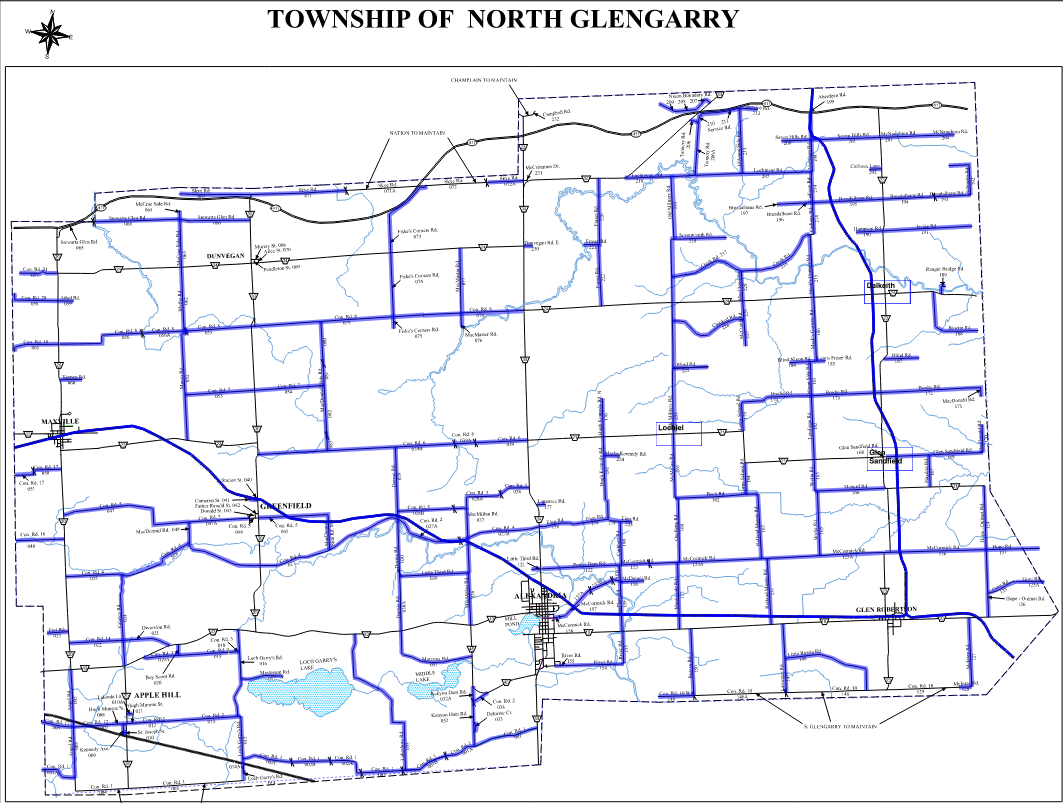
Significant Weather Event – As per Regulation 239/02 of the Municipal Act 2001, an Ontario municipality may declare a significant weather event when a weather hazard is approaching or occurring and has the potential to pose a significant danger to users of the highways in which they have authority over. See map below for roads in which North Glengarry has authority over.

This declaration suspends the standard timelines required for municipalities to meet their winter maintenance objectives until the municipality declares the significant weather event has ended. In each case, during the course of a declared significant weather event, the standard for addressing winter maintenance is to monitor the weather and to deploy resources to address the issue starting from the time that the municipality deems it appropriate to do so. When the municipality has declared the event has ended, the standard timelines for winter maintenance activities will begin.

North Glengarry may declare a significant weather event when the weather forecast, or actual weather condition includes one or more of the following conditions:

  • Significant snow accumulation during a 24-hour period,
  • Ice formation that occurs with no warning from the weather forecast,
  • High winds leading to large snow drifts,
  • Cold temperature when de-icing operations will not be effective.

North Glengarry wishes to note that the declaration of a significant weather event is not notice of a reduced level of service or a road closure. The declaration is to notify the public that due to the current or forecasted conditions, caution is to be observed when travelling on North Glengarry roads and sidewalks and that it may take longer than usual to bring the condition of the roads and sidewalks back to a state of repair.

North Glengarry will notify the public that a significant weather event has started and or ended in the following ways;

  • North Glengarry website
  • Social Media (i.e. Facebook, Instagram)

For further information on the declaration of significant weather events, follow the weblink to the Ontario Regulation 239/02 here: https://www.ontario.ca/laws/regulation/020239


North Glengarry Snow Plow Route


Frequently Asked Questions

  • There are three classifications of roads within SDG Counties: Provincial, County and Municipal/Township roads. Each road network has a different level of service.
  • Provincial roads, managed by Ontario Ministry of Transportation are responsible for Highway 138, 401 and 417.
  • SDG County Roads are identified by number within a white “Keystone” or “Flower Pot” symbol. County roads are designed to a higher standard with a wider platform and asphalt surface. These are generally longer roads joining municipalities across SD&G.
  • Municipalities are responsible for the smaller, collector roads and neighbourhood streets. Municipal roads are identified by name and can have either an asphalt or gravel surface.

  • To optimize plowing efficiency, plows are dispatched to their assigned routes from three different Township patrol yards. Most routes start at, or are very close to, each of these yards.
  • If the plow is travelling with its plow and wing up, it is either out of service or heading to its assigned route.
  • Various municipalities and private contractors use County Roads to reach their assigned routes on local roads. They are commonly mistaken for County plows.

By law, snow must be removed from the travelled portion of the road. Plows are designed with a fixed blade and wing that always pushes the snow towards the ditch, or in some cases, driveways.

This is a common complaint in every municipality that is affected by the winter. There have been multiple strategies and options reviewed by a variety of cities and municipalities in the past. Unfortunately, none of them work or they prove too costly. There is little that the Township can do to prevent this occurrence. It is best to remove the snow from your driveway early and often to prevent ice buildup in the snow bank.

  • The roads are quite wide and require multiple passes to remove all snow from the roadway.
  • Additional clearing of the shoulders improves sight lines and creates more snow storage space for the next winter event.

Plows do not deviate from regular routes - if they did, the snow removal operations would take twice as long and would leave some roads in a dangerous state.

If you have an appointment, please monitor the weather and plan ahead.

In a true emergency, emergency services will contact the necessary offices to ensure our efforts and response are coordinated.

No! Under the Highway Traffic Act, it is illegal to deposit snow or ice on a roadway.

Local municipalities are responsible for the maintenance of all sidewalks and pedestrian crossings.

The Township is responsible for the maintenance of the sidewalks on county roads and the United Counties of Stormont, Dundas and Glengarry is responsible for the road surface.

In a perfect world, this could be coordinated, but in reality neither the Township, nor the County know when they are going to initiate winter operations.

Ultimately there is no easy solution, but, sidewalks typically require multiple passes anyway, so it is not a large hinderance.

The Township’s service level and budget allocation for winter control on sidewalks is to maintain them to a snow-packed condition, and sidewalk plows/blowers are not capable of clearing snow and ice from sidewalks to the extent that bare concrete is exposed in all conditions.

Snow and ice often bonds to the concrete during extreme temperatures, and ice can also form on snow packed sidewalks during thaw/freeze cycles.

Other factors, such as overgrown sod on the edge of the sidewalk or a buildup of residual ice and snow under wheel tracks, can cause the edge of the plow or blower to ride above the surface of the sidewalk. All affected areas are treated with abrasives for traction.

This is done when fluctuating temperatures are causing melting snow/ice that freezes as the temperature drops, resulting in slippery conditions on the sidewalks.

The Township sidewalk plows these areas in the interest of public safety to prevent slip and falls.

The sanding process involves travelling the entire route to identify areas that require sanding; although the plow may not have been applying sand when you saw it, there may have been conditions elsewhere along the route that required sanding.

Property owners are responsible for the removal of snow from around their mailbox.

If it is determined by staff that the mailbox was damaged because it has been physically struck by any part of the plow, the Township will repair or replace the mailbox with a standard metal mailbox and 4X4 post meeting Canada Post’s standards.

When one sees the plow’s flashing blue lights, please move over to give operators room to work. This includes intersections where the plows are required to back up multiple times to clear the intersection.

If you believe your vehicle has been damaged by a plow, please contact your insurance company, and advise our office at 613-525-3087.

  • The Township strives to prevent the loss of granular from its shoulders. Unfortunately, due to weather conditions, this is sometimes unavoidable.
  • As the snow melts there are areas where it will seem that there is a significant amount of granular material pushed into the ditch. In most cases the actual loss of granular tends to be minimal and is usually contained within the right of way.
  • Unfortunately, we do not have the necessary resources to cleanup the granular lost from our shoulders as a result of winter operations.
  • When clearing your driveway please keep the snow on your property, not on the road. Pushing snow back onto or across the road creates unsafe road conditions for motorists and is prohibited by the Highway Traffic Act.

Sign up to our News and Notices

Stay up to date on the Township's activities, events, programs and operations by subscribing to our news and notices.